
Complete Process and Key Precautions for Aircraft Scheduled Maintenance Checks (A/C/D Checks)
Time:
2026-08-04
Aircraft scheduled maintenance checks are the most critical and systematic preve
Aircraft scheduled maintenance checks are the most critical and systematic preventive maintenance activities within the aviation maintenance system. Conducted at prescribed intervals based on flight hours, flight cycles, or calendar time in accordance with the manufacturer’s maintenance program, these checks involve graded inspections, testing, repairs, and servicing. Their purpose is to identify and eliminate potential defects in a timely manner, maintain the aircraft in a continuing airworthiness condition, and ensure both flight safety and operational efficiency.
Depending on the depth of work and inspection interval, scheduled checks are typically classified as A-Checks, C-Checks, and D-Checks (some aircraft types still retain a B-Check, although most operators have incorporated B-Check tasks into A-Checks or C-Checks). Specific intervals and task content vary by aircraft type (Boeing, Airbus, COMAC C919, etc.). Actual execution must always be based on the latest effective Maintenance Planning Document (MPD) / Maintenance Review Board (MRB) report for the specific aircraft type and the operator’s approved maintenance program. This article presents the general process for A/C/D Checks, including work content, standard workflow, and key precautions, for the reference of maintenance personnel, engineering managers, and related professionals.
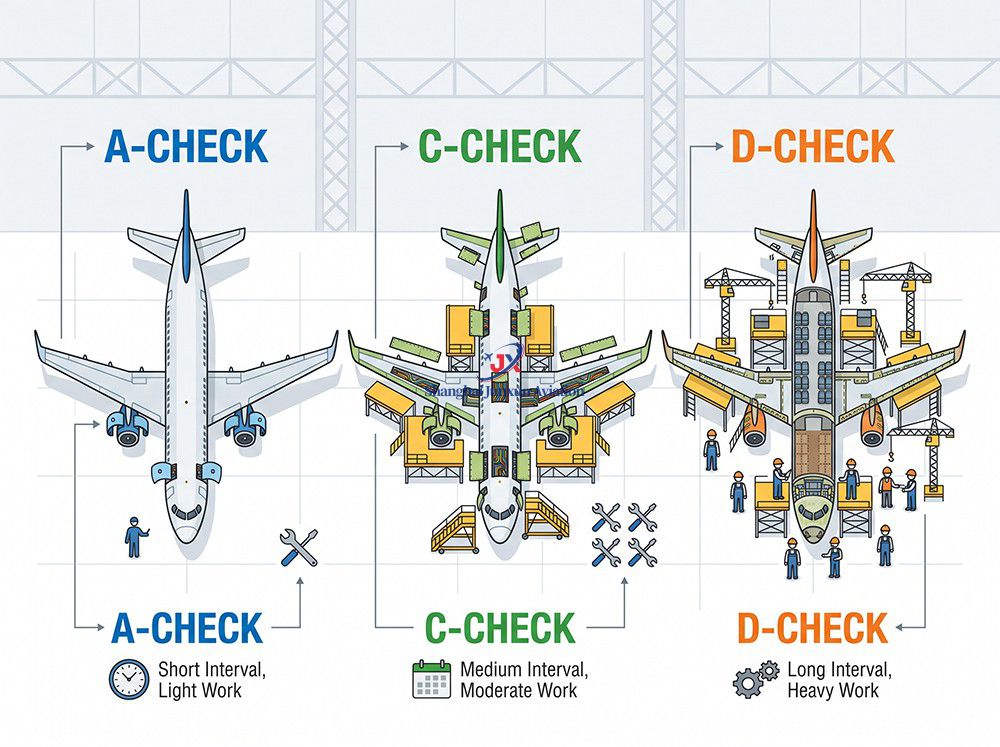
1. Overview of A/C/D Check Types and Intervals
Check Type | Typical Interval | Work Depth | Typical Downtime | Main Work Content |
A-Check | 400–600 flight hours or 200–300 cycles | Light | Several hours to 1–2 days | Visual inspections, lubrication, filter changes, simple functional tests, general servicing |
C-Check | 18–24 months or 3,000–6,000 flight hours | Medium | 1–2 weeks | Detailed system checks, partial structural inspections, component replacements, in-depth functional tests, implementation of applicable ADs/SBs |
D-Check | 6–12 years (depending on aircraft type) | Heavy | 1–2 months or longer | Comprehensive structural inspections, corrosion protection, interior and insulation removal/installation, major component overhaul, work approaching heavy maintenance level |
Many airlines now adopt “equalized check” or “phased C-Check” concepts, distributing traditional C-Check tasks across multiple shorter ground times to improve aircraft availability. Regardless of the approach, the core principles remain unchanged: all tasks must be performed in accordance with approved task cards, and complete documentation and airworthiness release must be accomplished.
2. Standard Workflow for Scheduled Maintenance Checks
Scheduled maintenance is a multi-disciplinary, multi-stage systematic process that typically progresses through the following seven phases.
2.1 Pre-Planning and Preparation
This phase forms the foundation for successful check execution. The engineering planning department must accurately determine the check type and task scope based on the aircraft’s current flight hours, cycles, calendar time, and maintenance history. Key activities include:
· Retrieving aircraft maintenance history, outstanding deferred items, applicable Airworthiness Directives (ADs), and Service Bulletins (SBs).
· Compiling a complete work package and generating routine task cards as well as anticipated non-routine cards.
· Preparing material requirements lists, tool and equipment lists, and special equipment needs (e.g., cranes, docking, ground power units).
· Verifying personnel qualifications (licenses, authorizations, and specialized training) and arranging shifts and man-hours appropriately.
· Coordinating the ground time window with operations, maintenance, material, quality control, and production control departments to ensure materials, personnel, and facilities are available.
The quality of preparation directly determines subsequent execution efficiency and safety risk levels.
2.2 Aircraft Reception and Induction
Upon arrival, the aircraft undergoes an initial visual and condition inspection: confirming no visible damage, fluid leaks, or abnormalities on the airframe, landing gear, engines, and control surfaces; verifying aircraft documentation (technical log, maintenance records, release certificates, etc.); and confirming the status of fuel, hydraulic, and electrical systems. After completing the induction checklist and recording any risk notes, the aircraft formally enters the maintenance status.
2.3 Access and Opening
In accordance with task card requirements, inspection panels, fairings, floor panels, ceiling panels, and sidewalls are systematically opened to provide access for inspection and repair. Particular attention must be paid to:
· Preventing loss or damage of panels and fasteners.
· Implementing Foreign Object Debris (FOD) control.
· Applying protective measures for composite structures and electrostatically sensitive areas.
· Strictly enforcing fall-protection and safety harness requirements for work at height.
2.4 Inspection and Testing
This is the core phase of the check. Work content varies by check type:
· Visual and detailed inspections of structure, systems, wiring, tubing, and fasteners for cracks, corrosion, wear, deformation, or leakage.
· Special inspections, including Non-Destructive Testing (NDT) methods such as ultrasonic, eddy current, penetrant, radiographic, or infrared inspection as required.
· System functional and performance testing, including power-on checks, operational checks, and performance verification.
· Focused structural inspections, particularly during C- and D-Checks, on primary load-bearing structures and corrosion-prone areas.
Any findings that exceed limits must immediately generate a Non-Routine Card (NRC) and be evaluated and dispositioned in accordance with established procedures.

2.5 Repair, Replacement, and Modification
Based on inspection results and task card requirements, repairs, component replacements, or modifications are performed. All work must:
· Be accomplished using approved maintenance data (Aircraft Maintenance Manual – AMM, Structural Repair Manual – SRM, Component Maintenance Manual – CMM, etc.).
· Use only approved materials and correct tools.
· Have critical steps inspected and signed off by authorized inspectors.
· Strictly follow torque, locking, sealing, and cleanliness process requirements.
All applicable Airworthiness Directives and Service Bulletins must also be accomplished.
2.6 Reassembly and Functional Verification
After repairs are completed, reassembly is performed in reverse sequence. Post-reassembly verification includes:
· System power-on and functional testing.
· Leak checks (fuel, hydraulic, pneumatic, etc.).
· Operational and performance checks.
· Engine runs, taxi tests, or test flights when required by the depth of the check and company procedures.
2.7 Documentation Closure and Airworthiness Release
All task cards must be fully signed off, maintenance records accurately completed, and weight-and-balance data updated if changes have occurred. Only after an authorized person issues the Certificate of Release to Service (CRS) may the aircraft be returned to the operations department for revenue service.
3. Specific Precautions by Check Type
A-Check Work is relatively light but performed under tight turnaround pressure. Emphasis must be placed on preventing missed inspections and tool left-behind; lubrication points must be correctly addressed; filter orientation and sealing after replacement are critical; and quality control steps must not be compromised even during rapid release.
C-Check System checks and partial structural inspections are equally important. Multi-disciplinary concurrent work is common, making interface management and handover records particularly critical. Completeness of the work package and timely evaluation/closure of non-routine work are key management focuses. Attention should also be paid to the effects of prolonged power-on testing on equipment and to personnel fatigue.
D-Check Work approaches heavy maintenance levels. Comprehensive structural inspections, corrosion control, large-scale removal of interiors and insulation, and detailed examination of wiring and tubing are of primary importance. During the extended downtime, aircraft corrosion protection, environmental controls, and progress management of components sent for overhaul must be rigorously controlled. Receiving inspection of major components (landing gear, flight control components, etc.) after overhaul must not be overlooked.
4. General Key Precautions
1. Safety First Strict protective measures must be applied for work at height, high-pressure systems, fuel areas, hydraulic systems, electrical systems, and any radiation sources. Any operation that could affect safety must first undergo risk assessment.
2. Human Factors Control Task cards must be followed strictly; work from memory is prohibited. Tool control and FOD prevention must be enforced. Shift arrangements should minimize fatigue. Critical steps require cross-checks or dual confirmation.
3. Documentation and Compliance All work must be supported by current approved data. Findings exceeding limits must be reported promptly. Maintenance records must be accurate, complete, and fully traceable.
4. Material and Tool Control Only approved materials may be used. Tools must be within calibration validity. Special tools must be used strictly in accordance with their instructions.
5. Multi-Disciplinary Coordination When structural, systems, avionics, and engine trades work concurrently, interfaces must be clearly defined and formal handovers with on-site communication maintained.
6. Environmental Protection Waste fluids, materials, and chemical cleaning agents must be collected and disposed of in accordance with regulations to prevent pollution.
7. Quality Oversight Critical inspection and repair steps must be inspected and signed by authorized inspectors. Final quality review must be completed before release.

5. Conclusion
Aircraft scheduled maintenance checks are not merely “inspections”; they constitute a systematic process integrating planning, execution, inspection, and documentation. Their quality directly affects the aircraft’s continuing airworthiness capability and operational safety. With the increasing application of predictive maintenance, digital task cards, and augmented-reality-assisted inspections, scheduled maintenance is evolving toward greater precision and efficiency. Nevertheless, the fundamental principles—working to approved data, strict process control, and complete documentation—remain unchanged.
The processes and precautions described in this article are provided for general reference only. In actual operations, the latest effective maintenance data for the specific aircraft type, the operator’s approved maintenance program, and applicable regulatory requirements must always take precedence. It is hoped that this article will serve as a useful reference for frontline maintenance personnel and maintenance managers in jointly safeguarding this critical line of flight safety.
Need Aviation Maintenance Tools or Ground Support Equipment?
Shanghai Junxun Aviation Technology provides professional aviation maintenance tools, engine maintenance tooling, Ground Support Equipment (GSE), aircraft maintenance docking systems, customized tooling solutions, and tooling rental services for commercial aircraft MRO operations worldwide.
Aircraft Coverage
Our tooling solutions support a wide range of Boeing and Airbus commercial aircraft, including :
Boeing
• Boeing 737 MAX
• Boeing 737 Next Generation (737NG)
• Boeing 757
• Boeing 767
• Boeing 777
• Boeing 787 Dreamliner
• Boeing 747
Airbus
• Airbus A220
• Airbus A320 Family
• Airbus A320neo Family
• Airbus A330
• Airbus A350
• Airbus A380
Engine Coverage
We also provide engine maintenance tools for leading commercial aircraft engine programs, including
CFM International
• CFM56-3/5/7
• LEAP-1A
• LEAP-1B
• LEAP-1C
GE Aerospace
• CF6-80C2
• GE90-94B
• GE90-115B
• GEnx
International Aero Engines (IAE)
• V2500
Pratt & Whitney
• PW1100G
• PW1400G
• PW2000
• PW4000
Rolls-Royce
• Trent 500
• Trent 700
• Trent 7000
• Trent XWB
Whether you need standard aviation maintenance tooling, custom-designed equipment, GSE, aircraft maintenance platforms, or tooling rental services, our engineering team is ready to provide reliable, cost-effective solutions tailored to your maintenance requirements.
Can't find the tool you're looking for? Simply send us the aircraft model, engine type, or OEM part number (P/N), and we'll recommend the right tooling solution for your maintenance application.


Contact Us
Tel:+86-18221227579
E-mail:terryluo@jxavtech.com
Conntact: Terry+86-19979533636
Add:Room 515,Building D,No 399 Jianyun Road,Pudong New District,Shanghai,China.

Copyright (©) 2022 Shanghai Junxun Aviation Technology Co.,Ltd.
